
The Sitting-Rising Test that Predicts Longevity
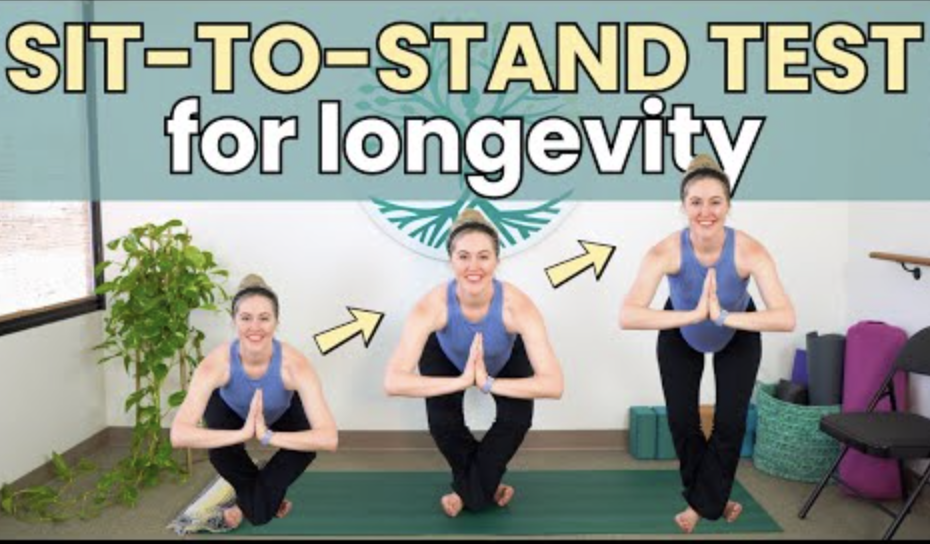
Here is a simple test you can try in about 10 seconds: Stand barefoot on a clear floor. Without holding onto anything, lower yourself into a sitting position on the floor. Then stand back up.
The challenge: try not to use your hands, knees, forearms or the side of your legs for support.
It sounds almost too simple to tell us anything meaningful about health. But researchers have been studying this movement for years, and the results are fascinating. Your ability to get down to the floor and back up again appears to be associated with how well—and potentially how long—you live.
It’s called the Sitting-Rising Test, or SRT.
How the Test Works
The formal test gives you five points for sitting down and five points for getting back up, for a maximum score of 10.
Each time you use a hand, knee or another support, you lose a point. If you noticeably lose your balance, half a point is deducted.
So someone who smoothly sits down and gets back up without using any support scores a perfect 10.
Don’t worry about making it fast. Despite sometimes being described as a “10-second test,” the research isn’t really testing whether you can complete it within exactly 10 seconds. What matters is how independently and steadily you can get down and back up.
What Does This Have to Do With Longevity?
Quite a lot, according to the research.
In a recent study, researchers followed 4,282 men and women between ages 46 and 75 for a median of more than 12 years.
Among people who scored a perfect 10, 3.7% died from natural causes during the follow-up period. Among those scoring 8, the rate was 11.1%. And among people with the lowest scores of 0–4, it was 42.1%.
Even after researchers adjusted for factors including age, sex, body mass index and several medical conditions, people scoring 0–4 had about 3.8 times the risk of death from natural causes and about six times the risk of cardiovascular death compared with people scoring 10.
That doesn’t mean failing the test causes you to die earlier. Nor does a perfect score guarantee a long life.
Instead, the test seems to capture several important aspects of physical health in one remarkably simple movement.
What Is the Test Actually Testing?
Try getting off the floor without your hands and you’ll quickly realize that this isn’t just a test of leg strength. It requires muscle strength and power to lift your body. It requires balance as your center of gravity changes. It requires flexibility and mobility, particularly through your hips, knees and ankles. It requires coordination to put all those movements together.
And body composition matters, too. Moving your own body becomes more difficult when there is more body mass relative to the muscle available to move it.
Researchers describe these collectively as components of non-aerobic physical fitness: strength and power, flexibility, balance and body composition.
That’s what makes this test so interesting. Most health measurements examine one thing at a time. Blood pressure measures blood pressure. A cholesterol test measures cholesterol. A strength test measures strength.
Getting yourself off the floor requires several physical systems to work together.
How to Improve
The encouraging thing about this test is that many of the abilities it measures can be trained.
If strength is the problem, resistance training is important. Squats, lunges, step-ups, bridges and other lower-body exercises can strengthen the muscles needed to get off the floor.
If balance is the problem, practice balance exercises regularly. Even simple exercises such as standing on one leg can become progressively more challenging as your balance improves.
If mobility is limiting you, work on hip, ankle and lower-body mobility. Stretching and mobility exercises can make it easier to move through the positions required to sit and rise.
And practice the movement itself. Start near a sturdy piece of furniture and use as much support as you need. Over time, try using a little less assistance.
The goal isn’t necessarily to score 10 tomorrow. The goal is to remain capable of moving your own body through the world as you get older.
Who Shouldn’t Try It?
This isn’t an appropriate home test for everyone.
Don’t attempt it on your own if you have a significant balance problem, a history of frequent falls, severe knee or hip problems, a recent injury or surgery, significant dizziness, or another condition that makes getting onto the floor unsafe.
The people in the recent study were screened before fitness testing and did not have physical or clinical limitations that prevented them from performing the test.
If you’re unsure whether you can safely get back up, don’t test yourself just to find out. A physical therapist or other qualified healthcare professional can assess your strength, mobility and balance in a safer setting.
At Massage Therapy Center Palo Alto, massage and assisted stretching can help address muscle tension and support comfortable mobility and flexibility. Combine that with regular strength and balance training, and you’re investing in something increasingly valuable with age: the ability to keep moving independently.