
The Book That Changes How You See the Second Half of Life
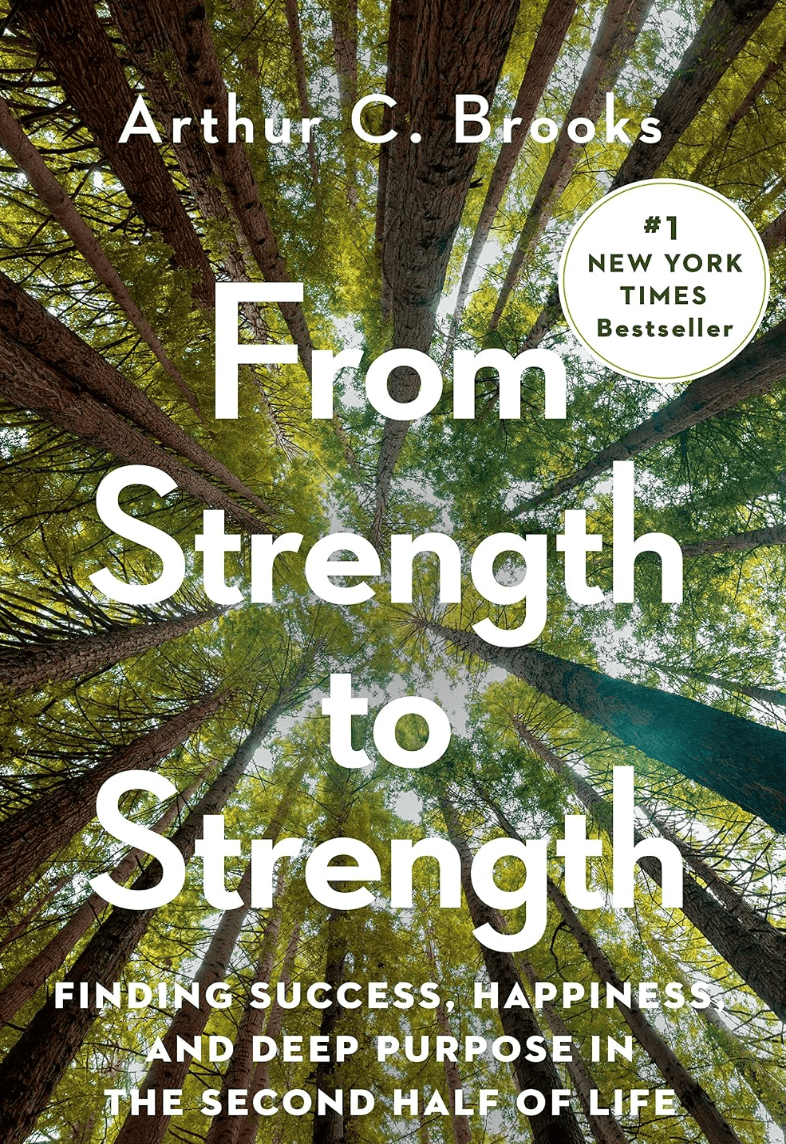
Arthur C. Brooks opens From Strength to Strength with a scene that is hard to forget. On a late-night flight, he overhears an elderly man tell his wife that nobody needs him anymore. The man sounds defeated, almost erased. When the passengers leave the plane, Brooks realizes he is famous—someone whose achievements once made him a hero.
At the time, Brooks was nearing 50 and thriving as president of the American Enterprise Institute. He had written successful books, delivered sought-after speeches, and met or exceeded the professional goals he had set at 40. Yet he was working roughly 80 hours a week, was not especially satisfied, and could sense that the pace could not continue forever.
The frightening question behind the book is not “Will I decline?” It is “If being excellent is how I learned to feel valuable, who am I when excellence becomes harder?” Brooks calls this the striver’s curse. The more identity we build around achievement, the more threatening normal change can feel.
The Bad News Arrives Early
Brooks does not soften the opening argument. In many careers that depend on speed, originality, or intense analytic horsepower, peak performance may arrive earlier than people expect. He tells the story of Charles Darwin, who transformed science yet spent later years judging his own work harshly. By the world’s standards Darwin remained monumental; by his own standard, he felt diminished.
Then comes the book’s turn: decline in one capacity is not decline in human worth, nor even the end of excellent work. Brooks distinguishes fluid intelligence—the speed and flexibility used to solve new problems—from crystallized intelligence, the accumulated ability to recognize patterns, exercise judgment, teach, and connect ideas.
The distinction is not as tidy as a motivational diagram. Modern research shows that different abilities interact and that people age differently. Still, the broad pattern is intriguing: a 2026 study using current adult intelligence measures found crystallized ability was generally maintained through ages 76 to 80, even as processing speed declined earlier. The second half can favor the professor over the prodigy, the editor over the soloist, and the mentor over the competitor.
The Most Surprising Idea Is Subtraction
Most self-improvement books ask what else you should acquire. Brooks asks what you can release. His rough formula is memorable: satisfaction is what you have divided by what you want. Increasing the numerator can become an endless project; shrinking the denominator may be more powerful.
That is why he proposes a reverse bucket list—not places to visit or trophies to collect, but attachments to loosen. The title you must keep. The need to be invited. The hope of appearing indispensable. The opinion you cannot bear to surrender. This is not resignation. It is refusing to let yesterday’s rewards run tomorrow’s life.
Five Experiments Inspired by the Book
1. Identify the Applause You Are Afraid to Lose
Finish this sentence privately: “If people stopped seeing me as ___, I would worry that I was no longer valuable.” Productive, smart, needed, attractive, successful—whatever appears is useful information. The book becomes far more personal once you can name the identity you are defending.

2. Move One Hour From Performer to Teacher
Take something you know deeply and help another person use it. Mentor a colleague, explain a family skill, advise a nonprofit, or write the one-page guide you wish someone had given you. Crystallized intelligence grows valuable through transmission, not private possession.
3. Make a Five-Item Reverse Bucket List
List five wants currently managing you. Choose one and write, “If I do not receive this, I will still be okay.” Do not throw away healthy ambition; test whether you can pursue something without making your peace depend on obtaining it.
4. Build Your “Aspen Grove”
Brooks uses aspens—separate trunks connected by one root system—as an image for relationships. Schedule one recurring meal, walk, or call with someone who knows more than your résumé. Across 148 studies involving 308,849 participants, stronger social relationships were associated with a 50 percent greater likelihood of survival. The research is observational, but the message is difficult to ignore.

5. Write a Purpose Small Enough for Tuesday Morning
Complete: “This year, I will use my experience in ___ to help ___.” A 2026 analysis of 488,765 people found greater purpose was associated with lower risk of earlier mortality, though it cannot establish causation. Purpose need not be grand; it needs somewhere to go on your calendar.
Why the Book Is Worth Reading
A summary can give you the two curves and the reverse bucket list. It cannot reproduce the book’s unsettling accumulation of stories, research, spiritual traditions, and candid self-examination. Brooks does not simply advise readers to age gracefully. He asks ambitious people to confront the bargain beneath ambition—and offers a plan for becoming happier without needing to become less alive.
Read it before a transition forces the question. Then begin with one hour: remove it from proving, and give it to teaching, loving, or serving. If you also need an hour to step out of urgency and return to your body, Massage Therapy Center in Palo Alto offers a calm place to pause and make room for the next strength.